Serving Palo Alto & Silicon Valley - Shipping Nationwide

RECORDING STUDIO SOUNDPROOFING IN PALO ALTO

Soundproofing a recording studio means two separate jobs that people often mix up. Sound isolation keeps sound from crossing the walls, ceiling, and floor that separate the studio from everything around it. Acoustic treatment tames the reflections and reverb inside the room so you get a clean recorded signal. You need both, and each calls for its own methods and materials. What’s possible also depends on whether you’re building from the ground up or retrofitting an existing room — an Eichler bedroom or a converted garage.

A List of Our Services

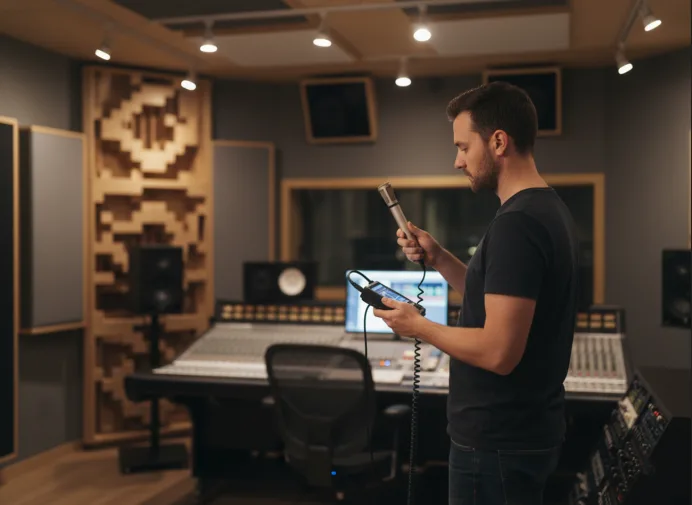
Acoustic engineer measuring RT60 with a handheld microphone in a recording studio

ACOUSTIC TREATMENT FOR RECORDING STUDIOS: CORE METHODS

Treating a recording studio comes down to three jobs: absorbing excess reflections to shorten reverberation time, scattering sound to stop flutter echo, and taming low-frequency buildup in the corners. A properly treated room reaches an RT60 of 0.3–0.5 seconds with an even frequency response across the space. Skip the treatment and even a perfectly isolated studio will color every take with room resonances and reflections.

Absorption Panels

Absorption panels are made of porous material — open-cell foam, fiberglass, or mineral wool. As sound pressure pushes air through the fibers, friction turns that acoustic energy into a small amount of heat. Their strength is the mid and high frequencies.

Panel thickness is what sets how low an absorber can reach. A 2-inch foam or fiberglass panel starts working at roughly 500 Hz; a 4-inch panel pulls that down to about 250 Hz. Below 250 Hz, ordinary panels barely register, and controlling the low end takes purpose-built bass traps.

Panels go at the first reflection points: the spots on the side walls, ceiling, and floor where the monitors’ sound bounces once on its way to the mix position. On each side wall, that’s roughly midway between the speakers and your listening seat. Overhead, it’s the ceiling area right above you. Treating these points cuts comb filtering at the mix position and makes the frequency response you hear far more accurate.

Bass Traps

Bass traps are thick, dense absorbers designed to work in the low-frequency band from 63 to 250 Hz. They live in the room’s corners — wherever two walls meet, or a wall meets the ceiling or floor.

Corners are where bass traps earn their keep, because low-frequency pressure builds up at room boundaries. Against a single wall it roughly doubles, where two walls meet it reaches about four times, and at a tri-corner — two walls plus the ceiling or floor — it climbs to roughly eight times. Stacking traps from floor to ceiling in each of the four vertical corners, and running them along the wall-ceiling junctions, puts absorption where the low-end energy piles up heaviest.

Leave out the bass traps and low-frequency room modes — resonances tied to the room’s dimensions — make some bass notes boom and others vanish at the mix position. Accurate low-end mixing becomes impossible, and anything recorded there will sound uneven in the bass once it plays on a neutral system.

Diffusion Panels

Diffusion panels scatter incoming sound in many directions instead of soaking it up. In a recording studio they usually go on the rear wall, behind the listening position, so the back wall doesn’t fire concentrated reflections straight back at the mix position.

Absorption and diffusion give a room very different character. Absorption removes reflections outright and shortens reverberation time. Diffusion spreads them out in time and direction, so the room keeps a sense of space while direct echoes disappear. Cover a studio entirely in absorption and it goes acoustically “dead” — takes lose their natural ambience and sound oddly squashed. The standard recipe is absorption at the first reflection points plus diffusion on the rear wall: a front-dead, rear-diffuse room that works for both mixing and tracking.
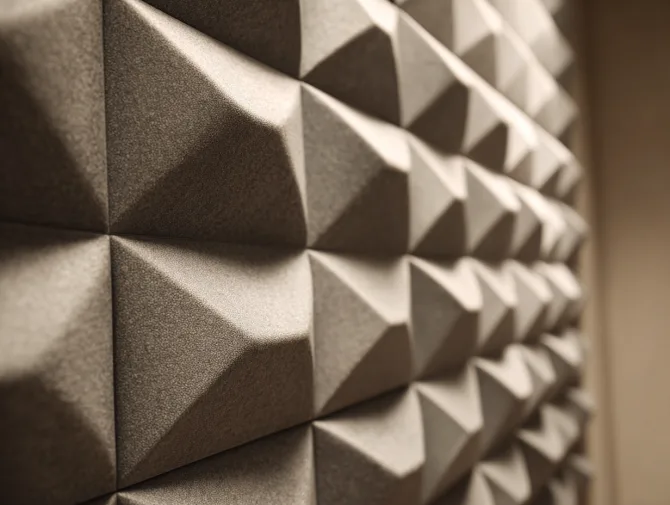
Geometric acoustic absorption panels on a studio wall, close up

RECORDING STUDIO SOUNDPROOFING SERVICES WE PROVIDE

We provide isolation and acoustic treatment for studios of every kind, whether it’s a commercial facility that needs a complete room-within-a-room or a home studio retrofit in a house or condo. Every project includes acoustic measurements before work starts, a design aimed at specific STC and NC targets, materials, and professional installation.

Studio types we design and build for:

  • Commercial and professional recording studios aiming for NC-15 to NC-20 with a full room-within-a-room build
  • Project and semi-pro studios set up in commercial or mixed-use buildings
  • Home studios in single-family houses, where a retrofit can reach STC 50–55
  • Home studios in condos and apartments, shaped by isolation limits from neighboring units
  • Voiceover and podcast booths for corporate teams, broadcasters, and independent creators
  • Broadcast and radio studios with strict background noise and isolation specs
  • Rehearsal rooms, where the main goal is keeping sound away from nearby businesses or neighbors

Our acoustic panels and baffles come from our own production shop, so we can build them to the exact dimensions a project calls for and tune their performance — NRC, thickness, facing material — to the acoustic targets of the room.

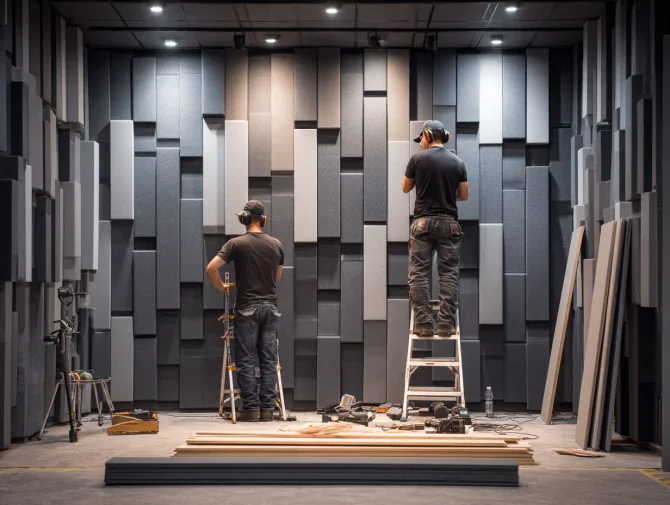
Two installers mounting acoustic panels on a recording studio wall

OUR STUDIO PROCESS

Every studio job starts on site, with measurements. How a studio sounds depends on room geometry, construction type, and noise sources in and around the building — Caltrain horns, US-101 traffic, a neighbor’s heat pump. Designing from measured data fits the solution to real conditions, not a generic spec.

On-Site Acoustic Assessment

We measure RT60 at several positions in the room, background noise (NC rating) with the HVAC running, and outside noise at the building envelope. On retrofit jobs we also test how the existing walls perform, using source and receiver levels across frequency bands to establish their STC. The assessment report records these baseline conditions and spells out the isolation and treatment needed to hit your target NC.

Treatment and Isolation Design

From the measurement data we build the full plan: wall assemblies with projected STC by frequency band, a panel layout backed by RT60 modeling, bass trap locations, door and window upgrades, HVAC silencer sizing, and a floating floor where the project needs one. The design records the expected performance of each element and the composite NC you can expect inside the finished room. In occupied buildings, we sequence installation to minimize disruption.

Installation & Verification

Our own crew does the installation. When it’s finished, we repeat the RT60 and NC measurements at the exact positions used in the assessment. The post-installation report shows the RT60 and NC actually achieved and, when wall STC was the main goal, the measured transmission loss by frequency band. You receive both reports — before and after — as a verifiable record of how the room performs.

Control room with a mixing console, monitors, and acoustic panels on the walls

WHY TRUST US WITH RECORDING STUDIO SOUNDPROOFING

Studio clients come to us for three reasons that decide whether a project actually hits its acoustic targets: hands-on experience with the construction conditions studio soundproofing involves, the ability to fabricate acoustic materials to project specs, and a measurement-based process that documents the results objectively.

Hands-On Experience with Pro and Home Studio Projects

As a division of New York Soundproofing, our team has delivered soundproofing and acoustic treatment for every kind of studio — multi-room commercial facilities, project studios, and home setups in apartments and single-family homes. Each type comes with its own building conditions, noise problems, and performance goals, and we’ve worked through each one.

Acoustic Panels and Baffles Made in Our Own Shop

We fabricate our own acoustic panels and baffles. Producing them in-house lets us size each panel precisely to the room’s geometry, choose the absorber thickness that matches the frequency range needing treatment, and pick a facing — fabric, perforated metal, or sealed fiberglass — that suits the studio acoustically and visually.

Acoustic Measurements Before and After Installation

Measurements before and after installation are part of every project. The first set establishes baseline RT60 and NC; the second documents what the work achieved. Both reports come to you in writing — an objective record of the room’s acoustic performance that doesn’t depend on anyone’s ears.

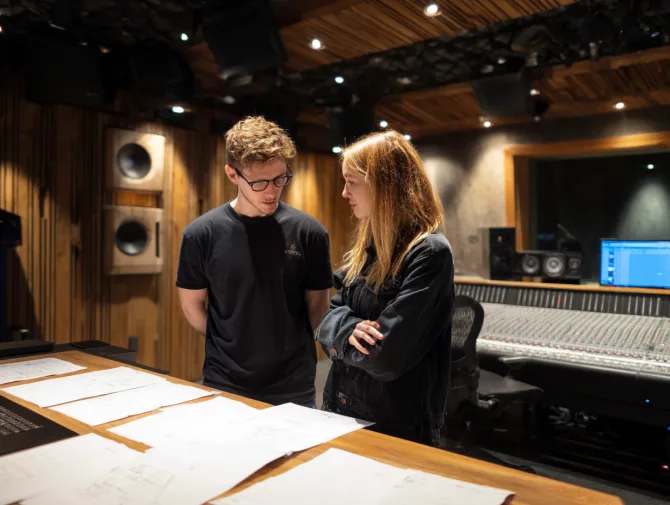
Client and acoustic engineer going over plans at a studio mixing console

BOOK YOUR RECORDING STUDIO ACOUSTIC ASSESSMENT

During your assessment, we take RT60, NC, and outside noise readings where your studio is, and evaluate the existing construction for the STC it delivers now and what it could reach. For new builds, we review site conditions and structure type to confirm which isolation targets are realistic. You get a written report with baseline data, the recommended approach, and projected performance targets. There’s no obligation to go ahead.

Frequently Asked Questions

What separates a home studio from a professional studio when it comes to soundproofing requirements?

A professional studio aims for NC-15 to NC-20 and needs STC 60–70, which only room-within-a-room construction on a floating floor can deliver. A home studio, aiming for NC-25 to NC-35, needs STC 50–55 — reachable by retrofitting an existing room with decoupled drywall and MLV. Treatment methods are much the same for both; the difference lies in isolation level and build method.

How can I cut HVAC noise in a recording studio?

HVAC noise reaches a studio two ways: as airborne sound carried through the ductwork, and as structural vibration from fans and compressors traveling through the building frame. Acoustic duct silencers where the ducts enter the studio take care of the airborne part. Isolation pads or spring hangers under all HVAC equipment handle the vibration. And keep air velocity at the supply diffuser under 300 feet per minute, or the airflow itself becomes audible.

When does a studio need a room-within-a-room, and what is it?

A room-within-a-room is a second studio shell (walls, ceiling, and floor) that stands as an independent structure with no rigid connection to the surrounding building. Any sound has to jump the air gap separating the two shells with no solid path, so vibration can’t transfer. You need one for a professional studio targeting NC-20 or lower, or for any room where drums, bass amps, or orchestral instruments will be recorded. Home studios and voiceover booths can usually get there with a decoupled retrofit.

Why do low frequencies need special treatment in a studio?

Bass between 63 and 250 Hz passes through ordinary wall assemblies with much less loss than mids and highs. The STC rating hides this: it’s calculated over 125–4000 Hz and weighted toward the midrange. On top of that, low frequencies pile up in corners, creating resonances that make the response at the mix position uneven. Each problem needs its own fix — room-within-a-room construction for isolation, bass traps for room modes.

Is it possible to soundproof a studio without construction?

To a point. Decoupled drywall on resilient clips raises a typical wall from STC 33–37 to 45–50. Door seals and automatic bottoms raise a door from STC 20–25 to 35–40. Absorption panels and bass traps involve no structural work. But professional-grade isolation at STC 60+ requires a full room-within-a-room, which means rebuilding walls and floors.

What STC rating should recording studio walls have?

Pro rooms at NC-15 to NC-20 need STC 60–70 and room-within-a-room construction. Home studios at NC-25 to NC-35 need STC 50–55, which a decoupled retrofit can reach. Voiceover booths at NC-35 to NC-40 need STC 40–50 — a prefab booth or one decoupled wall layer. Your exact figure comes from measured outside noise minus the target NC.

Soundproofing vs. acoustic treatment in a recording studio: what’s the difference?

Isolation stops sound from getting through walls, floors, and ceilings, and it’s rated in STC. Acoustic treatment governs what sound does within the room — echo, reflections, low-end buildup — and is gauged by RT60 and NC. Different problems, different tools, and any working recording studio needs both.

Acoustic Panels in Action

Hear the Before-and-After Difference

This video walks you through a real acoustic treatment project our team completed for Galaxy Visuals, a professional video production studio. You can hear the room before and after the acoustic panels went up.
The space went from acoustically unusable to genuinely great-sounding!
When the studio first moved in, the echo was so strong that clean audio on a shoot was out of the question, and even a normal conversation was hard to follow.

That's where we came in. We designed acoustic panels to suit the look of the room and placed them just outside the camera frame, so the studio got clean sound without changing a single shot. It's one of many projects where a room nobody could work in became a space built for recording, listening and more.

Reach out and let's talk about what your space could sound like! (Galaxy Visuals also recorded a client testimonial about the result.)

Palo Alto Soundproofing

Soundproofing Specialists for Palo Alto & Silicon Valley

Home offices, music rooms and home studios, recording studios, conference and video-call rooms, offices, restaurants, bars and clubs, houses of worship, school auditoriums - we build custom sound environments around the way each space is actually used.

View All Services

Start your project

Tell us about your space and we will get back to you

Start with a few basic details:

Rather talk by phone? (877) 999-2201

Additional info (Optional)