Serving Palo Alto & Silicon Valley - Shipping Nationwide

FLOOR SOUNDPROOFING

Kids racing across an upstairs bedroom, a neighbor’s TV rising through a townhome floor — sound moves easily between stacked rooms. Floor soundproofing slows it with added mass, a decoupled structure, and resilient layers. It handles two separate problems: impact noise, like footsteps and dropped objects, and airborne noise, like voices and TV.

Each type has its own rating and its own remedy. That’s why one product sold as the answer almost never cures a noisy floor by itself.

A List of Our Services

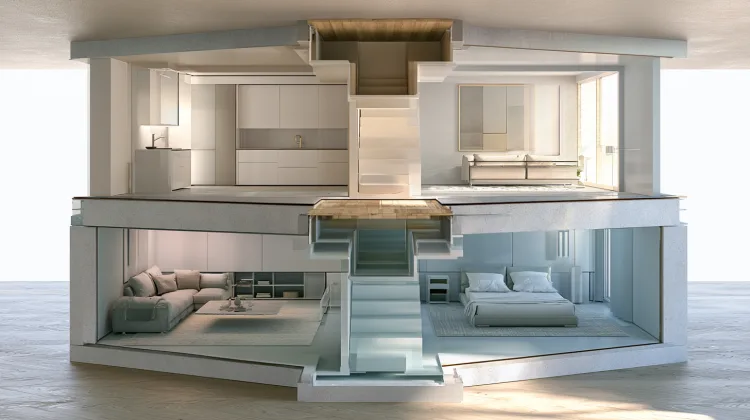
Cross-section of stacked rooms with a shared floor-ceiling assembly

STOP FOOTSTEPS AND VOICES FROM TRAVELING BETWEEN FLOORS

Noise between floors takes two forms, each with its own fix: impact noise from things striking the floor, and airborne noise carried through the floor-ceiling assembly by the air.

Most complaints are about impact noise. Footsteps, a dropped book, a chair scraping back, a dog on hardwood — each pushes vibration into the framing, which reappears as sound below.

The second problem is airborne. Conversation, music, and TV create sound waves that leak through gaps and light spots in the floor-ceiling assembly and reach the level above or below.

Solving one doesn’t solve the other. A floor can get much better at absorbing footsteps and still let voices through, since impact and airborne sound take different routes through the assembly.
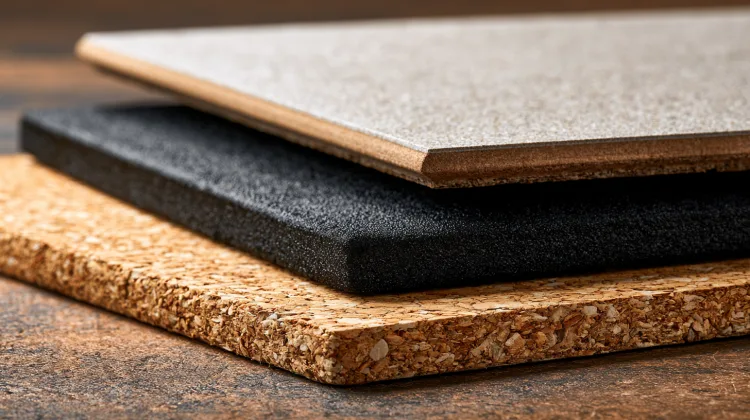
Cork, rubber, and mass-loaded underlayment layers stacked as samples

THE SCIENCE BEHIND FLOOR SOUNDPROOFING

To soundproof a floor correctly, you first need to know which rating applies to which noise. Footsteps and other impacts are scored with Impact Insulation Class, or IIC. Voices and music are scored with Sound Transmission Class, or STC. The bigger the number on either scale, the better the floor performs.

Impact control is about resilience and separation. A cushioned underlayment or a floating floor keeps the surface you walk on apart from the structure, soaking up vibration before it can reach the ceiling below.

Airborne control is about weight and airtightness. Dense layers added to the assembly, together with sealed gaps, stop sound waves that would otherwise slip through the thin parts of the floor-ceiling structure.

Acoustic underlayment — what most stores market as “floor soundproofing” — mostly helps with impact noise beneath a floating floor. It barely touches airborne noise and makes only a modest dent in heavy impact, so on its own it often disappoints.

You can also work from underneath. If the finished floor has to stay as it is, decoupling the ceiling of the room below and adding mass cuts both impact and airborne sound coming into that room.

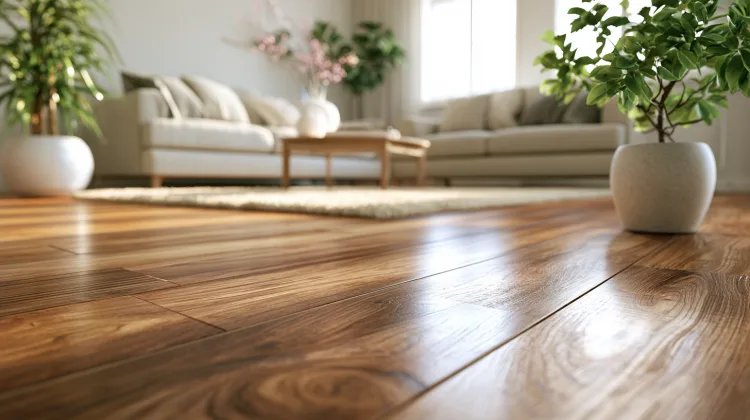
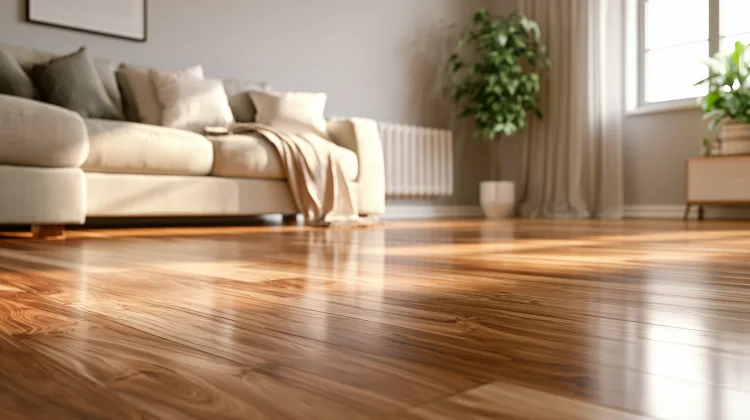
Living room with a warm-toned hardwood floor in soft natural light

FLOOR SOUNDPROOFING SERVICES FOR PALO ALTO HOMES

Our floor soundproofing services address both impact and airborne noise and can treat the assembly from the top or bottom, whichever side we can reach. Each service targets one specific floor noise problem.

Floating Floors and Acoustic Underlayment

A floating floor or acoustic underlayment puts a resilient layer between your finish flooring and the subfloor, cutting impact noise at the source. The assembly’s IIC climbs, and noticeably less footstep and contact noise reaches the room below.

Floor Decoupling With Added Mass

To control both impact and airborne noise from above, we decouple the floor and build up mass. A resilient mat topped with a dense layer isolates the walking surface and stops the airborne sound that underlayment by itself would pass.

Treating the Ceiling Below

If the upper floor can’t be pulled up or changed, we work on the ceiling underneath. Resilient channels or isolation clips decouple the lower room’s ceiling, heavier drywall adds mass, and impact and airborne noise reaching that room both drop. See our ceiling soundproofing page.

Impact Noise Control for Condos, Apartments and Townhomes

In stacked homes — apartments, condos, two-story townhomes — footsteps between units top the complaint list. We pair resilient isolation with mass to meet building requirements and limit noise passing between neighbors.

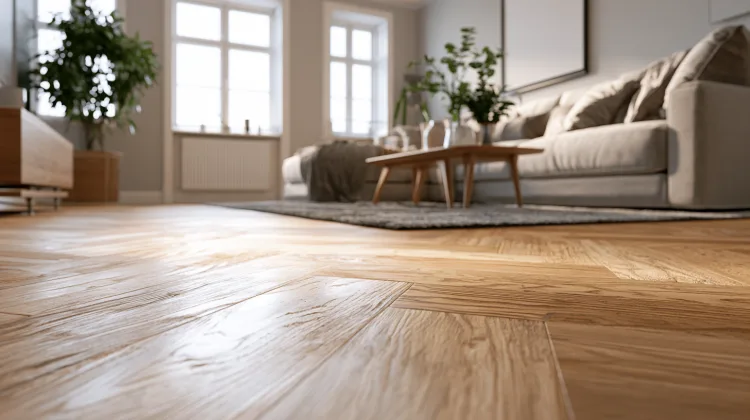
Sunlit living room with a polished wood floor

WHAT SETS OUR FLOOR SOUNDPROOFING COMPANY APART

Floor soundproofing succeeds when two calls are made right: whether you’re fighting impact noise, airborne noise, or both — and which side of the assembly to work on.

Licensed Crews With Two Decades of Acoustic Work

Every project gets a licensed crew with acoustic experience dating to 2002; Palo Alto Soundproofing is a division of New York Soundproofing. They’ve worked floor-ceiling assemblies from both sides, in homes and businesses, so your solution follows acoustic principles, not one product.

More Than an Underlayment Sale

We choose the treatment from the measured noise type rather than reaching for underlayment by default. That sidesteps a frequent mistake — laying a resilient underlayment to fix an airborne problem it was never built to handle.

Materials Made In-House

Many acoustic products we install come from our own production shop, and each is picked to suit the assembly and the noise involved. That lets us tune IIC and STC results to your particular floor instead of reusing one product everywhere.

Solutions for Occupied Homes and Buildings

We plan floor soundproofing for apartments, condos, townhomes, and ADUs with people living in them, including ceiling-side treatments when the unit above can’t be touched. That way, noise between neighbors comes down without tearing out a finished floor.

Installer unrolling acoustic underlayment ahead of a floating floor installation

OUR FOUR-STEP FLOOR SOUNDPROOFING PROCESS

Each floor project follows four steps, starting with data and ending with proof, so the assembly is treated for the noise it really has instead of a rule of thumb.

Site Visit: Impact, Airborne or Both

We find out whether the problem is impact, airborne, or a mix, and examine how the floor-ceiling assembly is built. That sets a baseline and shows which side to work from.

Setting IIC and STC Targets for the Design

The assessment results become an IIC target for impact noise and an STC target for airborne noise. With measurable goals on paper, the assembly is built to a standard, not to guesswork.

Installation From Whichever Side Works

We install on whichever surface we can reach — building up the floor from the top, or soundproofing the ceiling underneath. Sealing gaps and flanking paths is included in every job.

Final Measurement and Verification

After installation, fresh measurements are compared with the baseline. That shows the reduction your floor achieved in real life, rather than trusting a lab rating on its own.

Bright, quiet room with a gray sofa resting on wood flooring

WHAT NOISE REDUCTION A FLOOR CAN DELIVER

Floor soundproofing results are measurable, and they hinge on the noise type, the assembly, and the side you treat — not on what the packaging promises.

For impact noise, IIC and decoupling decide the outcome. Resilient underlayment beneath a floating floor usually adds only a modest gain against impact, while a completely decoupled floor or ceiling assembly goes considerably further.

For airborne noise, STC, mass, and sealing are what count. Underlayment alone contributes very little here, so a real airborne improvement takes extra mass and sealed seams throughout the assembly.

Treating from below has its limits. A decoupled, heavier ceiling lowers transmission into the room underneath, but how far it goes depends on ceiling height, framing, and the original build, as in an older College Terrace two-story.

Low-frequency thuds are the hardest part. Heavy footsteps and structural vibration carry deep energy that a thin resilient layer can’t stop; it takes decoupling and mass.

Calm apartment living room with warm-toned wood flooring

START YOUR FLOOR SOUNDPROOFING PROJECT TODAY

It begins with a site visit where we tell impact noise apart from airborne noise and set measurable IIC and STC goals. Then we design the assembly, install it from the right side, and confirm the result by measuring.

📞 Call Now to schedule a site visit, or Request Your Free Quote for a floor soundproofing plan tailored to your home!

Frequently Asked Questions

Can floor soundproofing get rid of every sound?

No. It lowers noise to a far less intrusive level but doesn’t create silence. Impact sounds and structural vibration are the toughest to remove, so the aim is a reduction you can measure and hear.

Which IIC and STC ratings should my floor reach?

California Building Code Section 1206 — adopted in Palo Alto through Municipal Code Chapter 16.04 — sets STC 50 and IIC 50 between new dwelling units, or 45 if field-tested. Your target depends on the building and complaint, so the assessment defines it first.

How can I quiet footsteps from an upstairs neighbor?

Since footsteps are impact noise, decoupling and resilient isolation work best. There are two routes: build up the floor upstairs with a resilient layer plus mass, or soundproof your ceiling with resilient channels or isolation clips and extra mass. Which one fits depends on whose surface you can access.

Is it possible to soundproof a floor without tearing it out?

Yes. If the finished floor needs to stay, we treat the floor-ceiling assembly from underneath, decoupling the ceiling of the lower room and adding mass. Impact and airborne noise reaching that room both go down.

Will acoustic underlayment soundproof a floor?

Not usually. Underlayment mainly softens impact noise beneath a floating floor and does little for airborne sound. It takes some edge off footsteps, but on its own it’s limited — serious floor soundproofing typically pairs a resilient layer with mass and sealing, or moves to the ceiling below.

How do impact and airborne noise differ when it comes to floors?

Think of it as touch versus air. Impact noise happens when something hits the floor — a footstep, a dropped pot — and IIC measures it. Airborne noise is sound traveling through the air, like voices or a TV, and STC measures that. Each needs its own treatment, and improving one doesn’t automatically improve the other.

Palo Alto Soundproofing

Soundproofing Specialists for Palo Alto & Silicon Valley

Home offices, music rooms and home studios, recording studios, conference and video-call rooms, offices, restaurants, bars and clubs, houses of worship, school auditoriums - we build custom sound environments around the way each space is actually used.

View All Services

Start your project

Tell us about your space and we will get back to you

Start with a few basic details:

Rather talk by phone? (877) 999-2201

Additional info (Optional)