
Serving Palo Alto & Silicon Valley - Shipping Nationwide

OFFICE SOUNDPROOFING IN PALO ALTO

Office noise comes in two forms, each with its own fix: sound moving between enclosed rooms, and sound piling up inside a shared room. Fixing one does nothing for the other. Sound moving between rooms is a transmission issue. When voices from a private office, meeting room, or HR area reach the space next door, the wall is failing to block - decoration won't change that.

Sound piling up inside a space is a reflection issue. An open-plan floor feels loud because hard surfaces throw voices and equipment noise back into the room, raising the level and wrecking concentration. Speech privacy is a third, related issue. A confidential talk in a meeting room or executive suite can stay intelligible next door behind a solid-looking wall, because gaps, shared ceiling plenums, and too little background sound let speech through.

A List of Our Services

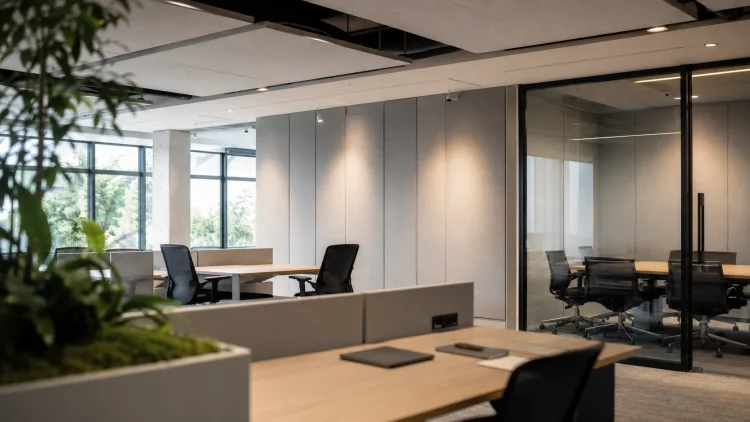
Glass meeting room beside an open office treated with acoustic panels and ceiling clouds

OFFICE SOUNDPROOFING VS SOUND ABSORPTION: KNOW THE DIFFERENCE

Soundproofing and sound absorption are two separate acoustic strategies for two separate problems. Mixing them up is the number-one reason office acoustic projects disappoint.

Soundproofing stops sound from crossing between spaces. It works through mass, sealing, and decoupling, and it is rated by Sound Transmission Class (STC) - the higher the STC, the less sound gets from room to room.

Sound absorption cuts echo and reverberation inside one room. It depends on soft, porous materials - acoustic panels, baffles, ceiling clouds - and is rated by Noise Reduction Coefficient (NRC), a 0-to-1 scale on which a higher number means the material soaks up more of the sound that hits it.

Absorption by itself won't keep sound from moving between rooms. Panels on a wall make that room less echoey, but they do very little to stop the meeting next door from overhearing you - that takes blocking.

Most offices need both: blocking (STC) for private offices and conference rooms, and absorption (NRC) plus sound masking for the open-plan floors Silicon Valley startups favor, busy with hybrid video calls.

Fabric-wrapped acoustic panel samples stacked in assorted colors

OFFICE SOUNDPROOFING SERVICES WE PROVIDE

Our office soundproofing services include blocking and absorption, chosen according to whether sound is leaking from room to room or building up inside a shared space. Every service below is aimed at one kind of office noise.

Wall and Ceiling Soundproofing for Private Offices

Wall and ceiling work stops sound entering or leaving a private office. We add mass, close gaps, and treat the shared ceiling plenum, raising the STC between rooms so conversations stay put. Every other privacy measure builds on this.

Confidential Conference Rooms and Meetings

For meeting confidentiality, we pair blocking with controlled background sound. Walls, doors, and the ceiling path are handled as one system, since even a high-STC wall won't keep a meeting private if sound slips over the top through a shared drop ceiling. Details on our conference room soundproofing page.

Acoustic Treatment for Open-Plan Floors

On an open floor, absorptive panels, hanging baffles, and ceiling clouds pull down echo and the general noise level. High-NRC surfaces shorten reverberation, so voices stop stacking up across the room and people can actually concentrate.

Sound Masking for Offices

Sound masking feeds a quiet, engineered background sound through speakers in the ceiling so speech doesn't travel as far. A slight, controlled lift in ambient level makes conversations harder to follow between desks and outside meeting rooms - more privacy without a louder office.

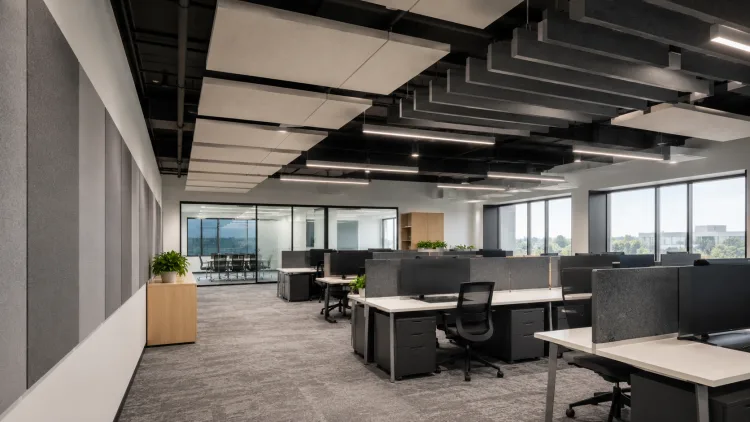
Shared office floor with hanging acoustic clouds and fabric wall panels

WHY WORK WITH OUR OFFICE SOUNDPROOFING TEAM

Office soundproofing succeeds when the diagnosis is right - blocking, absorption, or masking - and when the flanking paths that quietly sabotage most office acoustic work get treated too.

Licensed Installers, Decades of Commercial Acoustic Work

Our installers hold the required licenses and bring decades of commercial acoustic and soundproofing work. They know blocking and absorption equally well, so each design follows sound-engineering principles instead of whatever one product line happens to offer.

Blocking or Absorption: Diagnosed Before We Specify

Before we recommend a product, we work out whether each area calls for blocking, absorption, or masking. That avoids the expensive mistake of hanging absorptive panels to fix a transmission problem they can't touch.

Acoustic Materials Made in Our Own Shop

We make many of our acoustic materials in-house and choose each product for the measured problem. That control lets us tune STC and NRC performance to each area rather than force one solution on the whole office.

After-Hours Work That Keeps the Office Running

Installation fits around your operations, evenings and weekends included, so the office keeps working. Keeping downtime low is written into the scope from day one, not added later.

Installer fixing a fabric-wrapped acoustic panel to an office wall

THE OFFICE SOUNDPROOFING PROCESS, STEP BY STEP

Four stages take each project from first measurement to a confirmed result, so every area gets treated for the acoustic problem it really has - not one we assumed.

On-Site Assessment of Noise and Speech Privacy

We take noise readings and test speech privacy in enclosed rooms and open areas. That shows where the trouble is transmission from room to room and where it is reverberation inside a room.

Design Built Around STC and NRC Targets

Rooms that need blocking get an STC target; rooms that need absorption get an NRC target. With measurable goals on paper, each area is held to a standard instead of being treated by guesswork.

Low-Downtime Installation

Blocking, absorption, and masking systems go in on a timetable built to keep interruptions small. Flanking paths - ceiling plenums, gaps, and openings - are sealed as part of the same job.

Verifying Results with Sound Measurement

After installation, we measure noise and privacy again and compare them with the baseline. You see the improvement in the actual office, not just on a manufacturer's lab sheet.

Person working at a desk surrounded by acoustic privacy panels

WHAT NOISE REDUCTION OFFICE SOUNDPROOFING CAN DELIVER

Office soundproofing produces measurable gains, but how much depends on which problem you're solving and whether the flanking paths are treated - the label "soundproof" doesn't decide it.

Blocking between rooms comes down to STC and sealing. An ordinary interior partition does a poor job of privacy; confidential speech privacy usually takes a stronger assembly - around STC 50 or more - together with a solid ceiling path and every gap sealed.

On an open floor, absorption depends on NRC and on how much surface area gets treated. High-NRC panels and baffles shorten reverberation and bring the overall level down, but they won't produce silence, and they won't stop sound from traveling between rooms.

Flanking paths cap real-world results. Where offices share a drop ceiling and an open plenum, sound climbs over the wall, so a high-STC partition falls short until the ceiling path is treated.

Low-frequency noise is the toughest to control. Rooftop HVAC, which runs hard through warm Peninsula summers, produces long wavelengths that need more mass and decoupling than speech.

Minimal office corner with a single desk and an acoustic wall finish

BOOK YOUR OFFICE SOUNDPROOFING ASSESSMENT

Every office soundproofing project begins with an on-site assessment that sorts transmission from reverberation and sets measurable STC and NRC targets. Then we design, install, and verify the fix for each area.

📞 Call Now to set up your assessment, or Request Your Free Quote and get an office soundproofing plan built for your team.

Frequently Asked Questions

Can you soundproof our office without shutting it down?

Yes. We can work after hours and in phases so your team keeps its normal schedule. Most blocking and absorption treatments go in with very little downtime.

Does our office need sound masking, and what does it do?

Sound masking is a soft, engineered background sound delivered through the ceiling that makes nearby speech harder to understand. Open-plan offices and rooms where privacy matters benefit most, since conversations stop carrying far and the space doesn't get louder.

How can conference room meetings stay confidential?

Confidential meetings need three things working together: a high-STC wall assembly, a treated door and ceiling path, and enough background sound. A wall can look solid and still leak if speech escapes above it via a shared drop ceiling.

What makes an open-plan office quieter?

Open-plan noise responds best to absorption plus sound masking, not to walls and blocking. Panels and baffles shorten reverberation, and masking lifts the background level just enough that speech stops traveling across the floor.

Will acoustic panels alone soundproof an office?

No. Acoustic panels soak up sound and cut echo inside the room where they hang, but sound still reaches the next room. Keeping it out takes added mass, airtight sealing, and attention to the ceiling path - panels are only one part of the answer.

How does office soundproofing differ from sound absorption?

Office soundproofing stops sound passing between rooms and is rated in STC. Sound absorption tames echo inside a room and is rated in NRC. Blocking delivers room-to-room privacy, absorption prevents noise buildup within a space, and the typical office needs both.

Palo Alto Soundproofing

Soundproofing Specialists for Palo Alto & Silicon Valley

Home offices, music rooms and home studios, recording studios, conference and video-call rooms, offices, restaurants, bars and clubs, houses of worship, school auditoriums - we build custom sound environments around the way each space is actually used.

View All Services

Start your project

Tell us about your space and we will get back to you

Start with a few basic details:

Rather talk by phone? (877) 999-2201

Additional info (Optional)